AI Presentation
Quick Answer
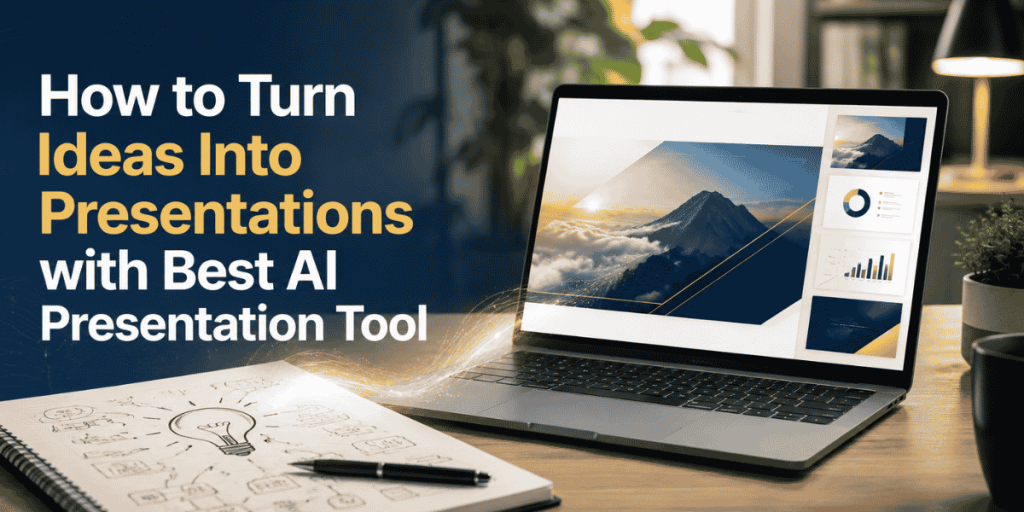
The best AI presentation tool helps teams turn rough notes, meeting ideas, sales points, lesson plans, and business concepts into structured slides faster. A strong workflow should help you create an outline, generate slide content, improve design, add visuals, prepare speaker notes, record the presentation, and reuse it as a training, sales, or education asset.
Most presentations do not start with a perfect idea. They start with messy notes in a document, half-written bullet points from a meeting, screenshots from a product demo, or a founder saying, “Can we turn this into a deck by tomorrow?”
That is where an AI presentation maker becomes useful. Instead of staring at a blank slide, teams can move from rough thinking to a structured deck that is easier to edit, present, record, and share.
This guide shows how sales teams, educators, founders, and business professionals can use AI to turn ideas into presentations—and then turn those presentations into recorded assets, training videos, webinars, proposals, and shareable business content.
0
Blank-slide panic
Start with notes, prompts, or outlines instead of building every slide manually.
4
Main deck uses
Sales decks, lesson slides, founder pitches, and business updates can all use the same workflow.
1x
Create once, reuse more
A strong deck can become a recorded presentation, training module, webinar, or proposal asset.
Table of Contents
The Real Reason Presentations Take Too Long
Most people think presentations take time because of design. But design is only one part of the problem. The harder part is deciding what to say, what to remove, how to structure the story, and how to make the deck useful for the audience.
A sales rep may have customer pain points but no deck structure. A founder may have a strong business idea but no investor-ready narrative. A teacher may have lecture notes but no clean slide flow. A manager may have meeting points but no polished internal presentation.
Simple rule: A good AI presentation workflow should not just make slides look better. It should make the message clearer.
| Common Presentation Problem | What It Causes | AI-Assisted Fix |
|---|---|---|
| Rough notes with no structure | Slides feel random or incomplete | Turn notes into a clear outline first |
| Too much text on each slide | Audience loses attention quickly | Convert long paragraphs into key messages |
| Weak visual hierarchy | Important points do not stand out | Use slide layouts that highlight one idea per slide |
| Deck is never reused | Team keeps creating from scratch | Record and repurpose the deck into assets |
What the Best AI Presentation Tool Should Help You Do
The best AI presentation tool should support more than slide generation. It should help you move from idea to structure, from structure to slides, and from slides to something your team can present, record, share, or reuse.
Flonnect’s AI Presentation Maker is useful for creating structured slides, improving content placement, and building professional-looking decks faster. For teams that also need video delivery, Flonnect can connect presentation creation with recording and sharing workflows.
| Feature | Why It Matters | Best For |
|---|---|---|
| Prompt-to-slide creation | Helps teams start from an idea instead of a blank deck | Founders, sales teams, educators |
| Outline generation | Turns rough notes into a logical story | Business professionals and trainers |
| Visual slide layouts | Makes ideas easier to scan and present | Marketing, education, and sales decks |
| Brand consistency | Keeps decks professional across teams | Businesses and agencies |
| Recording support | Turns slides into reusable training or sales videos | Remote teams, educators, sales teams |
A Practical Workflow: From Rough Idea to Finished Deck
AI works best when you do not ask it to “make a presentation” blindly. Give it direction. Tell it the audience, goal, tone, topic, slide count, and the decision you want the audience to make after the presentation.
Collect the raw material
Gather notes, meeting points, customer pain points, lesson topics, product screenshots, data points, or talking points. Do not worry about slide order yet.
Turn the idea into an outline
Ask AI to create a slide-by-slide structure. This step matters because a clear outline prevents the deck from becoming a random list of slides.
Generate the deck draft
Create the first version with slide titles, short copy, visual direction, and supporting points. Treat this as a strong draft, not the final version.
Edit for audience and delivery
Remove weak slides, simplify heavy text, add examples, and make sure every slide supports the audience’s decision or learning outcome.
How Different Teams Can Use AI Presentation Tools
The same AI presentation tool can support very different workflows. The key is to change the input. A sales deck needs proof and objections. A teaching deck needs clarity and learning flow. A founder pitch needs story, traction, and confidence.
For sales teams
Turn discovery notes, customer pain points, case-study points, and product benefits into proposal decks or follow-up presentations.
For educators
Convert lecture notes, lesson plans, and topic outlines into structured teaching decks that students can follow more easily.
For founders
Turn business ideas, market problems, traction points, and product direction into pitch decks or investor update slides.
For business professionals
Create internal updates, training decks, project summaries, meeting recaps, and webinar presentations faster.
If your deck needs to be delivered as a video, Flonnect’s presentation recorder can help record slides with webcam and audio, making the deck easier to reuse for training, webinars, or team updates.
AI Presentation Outline Template You Can Reuse
A good prompt gives AI a clear job. Instead of asking for a generic deck, use a reusable outline prompt that includes audience, goal, tone, slide count, and the core message.
Reusable AI presentation prompt
Create a [number]-slide presentation for [audience] about [topic]. The goal is to help them [decision or outcome]. Use a [tone] tone. Structure the deck with a strong opening, problem, key points, examples, proof, next steps, and a clear closing slide. Keep each slide focused on one idea and suggest visuals for each slide.
Example: Create a 10-slide presentation for sales teams about improving demo follow-ups. The goal is to help them send clearer post-demo summaries. Use a practical and persuasive tone. Include problem, workflow, examples, common mistakes, and next steps.
| Slide | Purpose | What to Add |
|---|---|---|
| Opening | Set the audience problem | A sharp statement, question, or situation |
| Context | Explain why it matters now | Market shift, workflow problem, or learning gap |
| Main points | Teach or persuade clearly | Three to five structured ideas |
| Example | Make the message practical | Scenario, workflow, comparison, or mini case |
| Closing | Guide the next action | Decision, task, CTA, or recap |
Create presentations from ideas faster
Use Flonnect AI Presentation Maker to turn rough notes, prompts, business ideas, lesson plans, and training topics into structured slide decks.
From One Deck to Sales, Training, and Shareable Assets
The smartest teams do not stop after creating a deck. They reuse it. A sales deck can become a recorded follow-up. A lesson deck can become a training video. A founder pitch can become an internal update. A webinar deck can become a content asset.
For screen-based delivery, Flonnect’s screen recorder supports screen, webcam, and audio recording for tutorials, demos, and presentations, helping teams turn a static deck into a reusable video asset.
| Original Deck | Reusable Asset | Where It Helps |
|---|---|---|
| Sales deck | Recorded proposal walkthrough | Post-demo follow-up and buyer education |
| Lecture deck | Recorded class lesson | Students who need replay or revision |
| Founder pitch | Investor update video | Async investor communication |
| Training deck | Employee onboarding module | HR, operations, and internal enablement |
If your recorded presentation needs captions or searchable notes, Flonnect’s video transcription workflow can help turn the recording into text that is easier to review, reuse, and share.
AI Presentation Tool Checklist Before You Choose
Before choosing an AI slide generator, do not only check whether it can create attractive slides. Check whether it supports the full way your team communicates: ideas, decks, recording, sharing, and reuse.
Choose an AI presentation tool that supports:
- Prompt-to-presentation creation for faster first drafts.
- Outline generation so the deck has a logical story.
- Slide layouts that improve clarity and visual hierarchy.
- Brand consistency for business and team presentations.
- Easy editing so humans can improve the final message.
- Recording support for webinars, training, sales, and education.
- Sharing options for async communication and team learning.
- Reuse potential across slides, videos, training assets, and proposals.
For teams building a wider AI content workflow, Flonnect’s AI solutions page includes tools for presentations, videos, thumbnails, images, social posts, and other creative assets.
Turn your ideas into presentation-ready assets
Use Flonnect to create AI presentations, record slide walkthroughs, and turn decks into reusable sales, training, education, and business communication assets.
FAQs
What is the best AI presentation tool?
The best AI presentation tool helps you turn rough ideas, prompts, notes, or outlines into structured slides that are easy to edit, present, record, and share.
How do I create a presentation with AI?
Start with a clear prompt that includes your topic, audience, goal, tone, slide count, and desired outcome. Then generate a slide outline, create the deck draft, edit the message, and prepare it for presentation or recording.
Can AI create PowerPoint-style slides?
Yes. AI presentation tools can help create slide-style decks from prompts, outlines, notes, or documents. Users should still review the final content, design, and accuracy before presenting.
Who should use an AI presentation maker?
Sales teams, educators, founders, marketers, trainers, consultants, and business professionals can use AI presentation makers to create decks faster and reduce manual slide-building work.
Why should I record a presentation after creating it?
Recording a presentation turns a one-time deck into a reusable asset. It can become a sales walkthrough, training video, class lesson, webinar replay, onboarding module, or internal update.
How does Flonnect help with AI presentations?
Flonnect helps teams create AI presentations, organize ideas into slides, record presentation walkthroughs, and reuse decks as training, sales, education, and business communication assets.